CIT 594 Assignment 5:
Parser
Spring 2010, David Matuszek
Note: This page prints badly under Firefox. I have not yet solved this problem. If you want to print this page, use a different browser.
Purposes
- To get you to use some of Java's supplied data structures
- To improve your understanding of recursion
- To teach more about recursive descent
But First...
Make the following changes to your Recognizer class, if you
have not done so already:
<program> ::= <command> { <command> } {
      <procedure> }
should be
<program> ::= <command> { <command> } {
      <procedure> } EOI
<expression> ::= [ <add_operator> ] <term> {
<add_operator> <expression> }
should be
<expression> ::= [ <add_operator> ] <term> {
    <add_operator> <term> }
<term> ::= <factor> {
      <multiply_operator> <term> }
should be
<term> ::= <factor> {
        <multiply_operator> <factor> }
General Idea
Your assignment is to write a parser for programs in the language
described by the Grammar in the Recognizer
assignment. A parser is a program that, given a stream of tokens, creates a
tree that represents the structure of the program
represented by that stream of tokens. Such a tree is called a parse tree, or
abstract syntax tree (AST) . The
"meaning" of this tree, if any, is outside the scope of this
assignment.
In this assignment you will build on the Tree and
Recognizer assignments. Make a copy of the Recognizer
class, and rename it Parser. Leave the other classes where
they are, and import them.Create an AllTests.java
JUnit class in the Parser project to include all the previous
JUnit tests, along with your new Parser tests.
The Parser class
I am providing starter code for
Parser.java and ParserTest.java.
This code can parse <expression>s and the other
nonterminals that go to make up expressions. You should read and become
familiar with all the provided starter code.
You will need to merge your Recognizer with this starter
code, keeping the most complete versions of each method. You will be
transforming your recognizer, which simply returns true
or false, into a parser, which creates a tree
corresponding to its input. We will use this parse tree later in
this course.
The Recognizer methods all return a boolean.
Don't change this. The Parser methods
will manipulate a global Stack<Tree<Token>>, but
will continue to return a boolean result.
For example, consider the grammar rule
    <term> ::= <factor> | <factor>
    { <multiply_operator> <factor> }:
| In the Recognizer: |
public boolean isTerm() {
    if (!isFactor()) return false;
    while (isMultiplyOperator()) {
        if (!isFactor()) {
            error("No factor after '*' or '/'");
        }
    }
    return true;
}
|
| In the Parser: |
public boolean isTerm() {
if (!isFactor()) return false;
while (isMultiplyOperator()) {
if (!isFactor()) {
error("No factor after '*' or '/'");
}
}
return true;
}
|
|
Notes:
- If the first
isFactor() succeeds, it leaves a Tree
representing that factor on the stack.
- If
isMultiplyOperator() succeeds, it leaves a Tree
leaf node on the stack, containing the multiply operator token ("*"
or "/").
- If the second
isFactor() succeeds, it leaves a
Tree representing that factor on the stack.
- If you get here, remove the top three Trees from the stack,
create a new one that represents this term, and leave it on the
stack. (Since you will be doing similar tree-building operations in
a lot of places, remember the DRY principle and write a method or
methods to do this work.)
|
Making parse trees:
The general idea is that as you recognize things in the input, you build
Trees to represent them, and push these Trees onto a stack. As you go
along, you pop Trees from the stack, combine them into a larger Tree, and
put this new Tree onto the stack. When you are done, you should have
exactly one Tree on the stack, representing the complete nonterminal
(usually <program>) being parsed.
For example, suppose you are trying to parse a
<condition> (defined as <expression>
<comparator> <expression>) and the string being parsed
is "x < 5 { \n". You will parse the x as an
<expression> by calling the expression()
method, which will leave a Tree representing this expression on the stack.
You do similar things for the <comparator> and the
second <expression>. Then you will pop these three Trees
from the stack, combine them into a single tree (with the
"<" Tree node as the root), and put the result back on the stack.
The remainder of the input string (in this case, "{ \n")
is left for later use.
First, it is important to realize that not everything goes into
the parse tree. Some tokens, such parentheses, braces, and newlines, are
there to help define the tree structure, or as an aid to the recognizer.
Some nonterminals, such as <expression> and
<term>, are in the grammar mostly to define the structure that
the resulting tree should have. In general, anything that provides
structure is represented in the structure of the tree; anything that
provides content is represented as nodes with values.
Second, there may be things in the parse tree that are not explicit in
the original program. For example, when you create a program
node, one of its children is a block to hold the statements in
the program (even though the grammar does not call for a
block), and another is a parameters node to hold the
list of formal parameters.
In the following table I will attempt to show what goes into the parse
tree for each grammar rule or rule alternative. Where a rule has more than
one alternative, the first column contains only the alternative that is
used in the example. Note that all node types have a fixed number of
children, with the exception of <list> and
<block>, each of which may have any number (including zero) of
children.
If there are discrepancies between the grammar given in the Recognizer assignment, and that shown below,
the one in the Recognizer assignment is the correct one.
| Grammar rule (partial) |
Example input |
What it should push onto the stack |
Comments |
<variable> ::= <name> |
"foo" |
 |
Leaf node, value is the name. |
<command> ::= <move>
<expression> <eol> |
"forward 5 \n" |
 |
The (one) child is the Tree that represents the
<expression>; the expression may be significantly more
complicated than this. |
<command> ::=

<move> <direction> <eol> |
"left 45\n" |
 |
The (one) child is the Tree that represents the
<expression>. |
<command> ::=

"penup" <eol> |
"penup \n" |
 |
Leaf node, value is the keyword. |
<command> ::=

"pendown" <eol> |
"pendown \n" |
 |
Leaf node, value is the keyword. |
<command> ::=

         "color" <color>
<eol> |
"color red \n" |
 |
The child is the Tree that represents the
<color>. |
<command> ::=

            "home"
<eol> |
"home \n" |
 |
Leaf node, value is the keyword. |
<command> ::=

          "jump"
<expression> <expression> <eol> |
"jump x y \n" |
 |
The children are the two expressions, in order. |
<command> ::=

          "set"
<variable> <expression> <eol> |
"set x w 5 \n" |
 |
The first child is the Tree that represents the
<variable>, while the second child is the Tree that
represents the (possibly complex) <expression>. |
<command> ::=

          "repeat" <expression>
<block> |
"repeat 5 { \n

           penup \n

} \n" |
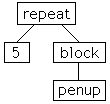 |
The first child is the Tree that represents the
<expression>, while the second child is the Tree that
represents the <block>. |
<command> ::=

          "while" <condition>
<block> |
"while x < 5 { \n

           penup \n

} \n" |
 |
The first child is the Tree that represents the
<condition>, while the second child is the Tree that
represents the <block>. |
<command> ::=

          "if" <condition>
<block> |
"if x < 5 {\n

           penup\n

}\n" |
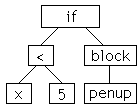 |
The first child is the Tree that represents the
<condition>, while the second child is the Tree that
represents the <block>. |
<command> ::=

          "if" <condition>
        <block> "else"
<block> |
"if x < 5 {\n

             penup \n

           }\n

           else {\n

             pendown \n

           }\n"
|
 |
The first child is the Tree that represents the
<condition>, the second child is the Tree that represents
the first <block>, and the third child represents
the second <block>. |
<command> ::=

         "do" <name> {
<expression> } <eol> |
"do foo 1 2 3\n" |
 |
The (required) first child of a do command is a name,
while the second child is a (possibly empty) list of expressions. |
<color> ::= "red" |
"red" |
 |
Leaf node, value is the keyword. Similarly for each other color
name. |
<block> ::= "{"
        <eol> { <command> } "}"
<eol> |
"{ \n

             penup \n

             home \n

             pendown \n

           } \n
|
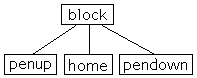 |
Each command is a child (subtree) of the block node. (To keep the
diagram small, I used only simple commands; each command might be a
large, complex subtree.) |
<comparator> ::= "<" |
"=" | ">" |
"<" |
 |
Leaf node, value is the symbol. Similarly for the two other
comparators. |
<condition> ::= <expression> <comparator>
<expression> |
"x < 5" |
 |
The children of a comparator node are arbitrarily complex binary
trees representing <expression>s. Only simple
expressions are used in this picture. |
<procedure> ::= "to"
        <name> { <variable> } <block> <eol> { <command> "end" <eol>
|
"to foo x y z{ \n

         forward x \n

         } \n"
"to foo a b c  \n

forward x \n

end \n"
|
 |
This is the most complex structure. A
<procedure> requires a <name>, a list
of <variable>s, and a <block>
(list of <command>s).
A "header" node is the parent of the <name> and
the (possibly empty) list of <variable>s. |
<program> ::= <command> { <command> } {
<procedure> } |
"penup \n

home \n \n to foo x y z { \n left x \n } \n" |
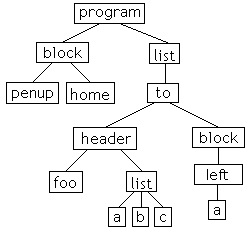 |
The root node is a "program" node, and each child is a "list"
node. Note that an empty list is represented by a "list" node with no
children. |
<eol> ::= "\n" {
"\n" } |
"\n" |
|
No binary tree is built. If something was put on the stack in the
process of recognizing the <eol>, it should be
removed. |
Order of evaluation:
An operation cannot be performed until its operands are known. When an
operation is represented by a node in a binary tree, that operation cannot
be performed until the children of that node have been evaluated. (This
requires a postorder tree traversal.) Therefore, the structure of
the binary tree imposes restrictions on the order in which operations are
performed.
For example, consider the expression 20 * 3 / 4. In this
expression, it is important to do the multiplication before doing the
division. Our parser might construct either of two trees from this
expression, only one of which is correct.
 |
This is the correct representation--if you evaluate the left
and right children, then do the division, the result is (20 * 3)
/ 4 = 60 / 4 = 15. |
 |
This is a wrong representation--if you evaluate the left
and right children, then do the division, .the result is 20 *
(3 / 4) = 20 * 0 = 0. (Remember, this is integer
division.) |
Note that you do not evaluate expressions in the current
assignment. However, you need to build the parse tree correctly so that you
can evaluate it correctly in a subsequent assignment.
Starter files:
Parser.java and ParserTest.java.
Due date:
Monday, March 15, before midnight. Turn in your program via Blackboard, and zip and
include all necessary packages from previous projects. (Open all
the required projects, close the others, choose File -> Export
-> Jar file -> Next>, and check the projects to be
included.)
It is your responsibility to check and make sure that you have
correctly submitted the correct files via Blackboard. Errors in the
submission process will not be taken as an excuse for late homework.