CIT 594 Assignment 8:
Parser
Spring 2012, David Matuszek
Purposes
- To get you familiar with trees
- To improve your understanding of recursion
- To teach recursive descent parsing
General Idea
Your assignment is to write a parser for programs in the language
described by the Grammar in the Recognizer
assignment. A parser is a program that, given a stream of tokens, creates a
tree that represents the structure of the program
represented by that stream of tokens. Such a tree is called a parse
tree. The "meaning" of this tree, if any, is outside the scope of this
assignment.
In this assignment you will continue to build on the previous assignments. To have everything in one place (this will simplify submitting your assignment), create a new RobotParser project, with the following packages:
-
tokenizer -- copy your Tokenizer, TokenType, and Token classes into this package.
parser -- copy your Recognizer class into this package, and rename it Parser. You will be adding code to each of the old Recognizer methods in order to add parsing functionality.tests -- put all your unit tests into the tests package, and write an AllTests.java JUnit class to run all your tests.tree -- I am providing a tree.zip file and Javadoc documentation for this package.
The Parser class
I am providing parserStarterCode.zip, which you should unzip and incorporate into your new Parser class, replacing the same-named methods in that class. This code can
parse <expression>s and the other nonterminals that go
to make up expressions. You should read and become familiar with all
the provided starter code.
The Recognizer/Parser methods all return a boolean.
Don't change this. The Parser methods
will manipulate a global Stack<Tree<Token>>,
but will continue to return a boolean result.
For example, consider the grammar rule
<expression> ::= <term> { <add_operator> <term>
  }:
| In the Recognizer: |
In the Parser: |
public boolean term() {
    if (!factor()) return false;
    while (multiplyOperator()) {
        if (!factor()) {
            error("No term after '*' or '/' or '%'");
        }
    }
    return true;
}
|
public boolean term() {
    if (!factor()) return false;     // Note 1
    while (multiplyOperator()) {     // Note 2
        swapTopTwoElementsOfStack(); // Note 3
        makeTree();
        if (!factor()) {             // Note 4
            error("No term after '*' or '/' or '%'");
        }
        else {
            makeTree();              // Note 5
        }
    }                                // Note 6
    return true;
}
|
|
Notes:
- If the first
factor() succeeds, it leaves a Tree
representing that factor on the stack.
- If
multiplyOperator() succeeds, it leaves a Tree leaf
node on the stack, containing the multiply operator ("*" or "/" or "%").
- Make a tree, with the
multiplyOperator at the root, and the factor as a child.
- The second
factor() should succeed. If it does, it leaves a Tree
representing that factor on the stack.
- Adds the second factor as a child of the multiply operator.
- If the loop continues with another multiply operator, the tree created above will be a subtree of it.
|
Making parse trees
The general idea is that as you recognize things in the input, you build
Trees to represent them, and push these Trees onto a stack. As you go along,
you pop Trees from the stack, combine them into a larger Tree, and put this
new Tree onto the stack. When you are done, you should have exactly one Tree
on the stack, representing the complete nonterminal being parsed.
For example, suppose you are trying to parse a
<condition> (defined as <expression>
<comparator> <expression>) and the string being parsed is
"x <= 5 {".
- Parse the
x as an
<expression> by calling the expression()
method, which will leave a Tree representing this expression on the stack.
- Parse the
<= as an <comparator> by calling the comparator() method, which will leave a (single node) Tree representing this comparator on the stack.
- Build a tree with
<= as the root and the expression as its child.
- Parse the second
<expression>.
- Add the new expression as another child of the root.
- The
"{" does not continue the<condition>, so leave it in the input to be parsed by a later call.
First, it is important to realize that not everything goes into the
parse tree. Some tokens, such parentheses, braces, and semicolons, are there to
help define the tree structure, or as an aid to the recognizer. Some
nonterminals, such as <expression> and
<term>, are in the grammar mostly to define the structure
that the resulting tree should have. In general, anything that provides
structure is represented in the structure of the tree; anything that
content is represented as nodes with values.
Second, there may be things in the parse tree that are not explicit in the
original program. For example, when you create a procedure node,
one of its children will be a parameters node to hold the list of formal
parameters.
In the following table I will attempt to show what goes into the parse
tree for each grammar rule or rule alternative. Where a rule has more than
one alternative, the first column contains only the alternative that is used
in the example. Note that all node types have a fixed number of children,
with the exception of <list> and
<block>, each of which may have any number (including
zero) of children.
If there are discrepancies between the grammar given in the Recognizer assignment, and that shown below, the one
in the Recognizer assignment is the correct one.
| Grammar rule (partial) |
Example input |
What it should push onto the stack
|
Comments |
<variable> ::= <name> |
foo |
|
Leaf node, value is the name. |
<thing> ::= <name> |
foo |
|
Leaf node, value is the name. |
<command> ::=

<thought> | <action> |
set foo 5; |
 |
A command is either a <thought> or an <action>, so whatever results from creating one of these is the result of creating a <command>. |
<action> ::=

<move> <expression> ";" |
forward 5; |
|
The keyword is the root, and the first child is the
Tree that represents the <expression>; it may be significantly
more complicated than this. |
<action> ::=

"turn" <direction> ";" |
turn right; |
|
The keyword is the root, and the argument is its child. |
<action> ::=

        "take" <thing> ";"
        |

"drop" <thing> ";" |
take rock ; |
|
The keyword is the root, and the argument is its child. |
<thought> ::=

         "set" <variable>
<expression> ";" |
set foo 5; |
|
The first child is the Tree that represents the <variable>,
while the second child is the Tree that represents the (possibly very complex) <expression>. |
<thought> ::=

         "repeat" <expression>
<block> |
repeat 5 {

          turn left;

          stop;

} |
|
The first child is the Tree that represents the <expression>,
while the second child is the Tree that represents the <block>.
(The <block> subtree is not shown in detail.) |
<thought> ::=

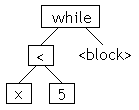
         "while" <condition>
<block> |
while x < 5 {

          turn left;

} |
|
The first child is the Tree that represents the <condition>,
(shown explicitly here) while the second child is the Tree that represents
the <block>. (The <block> subtree
is not shown in detail.) |
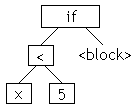
<thought> ::=

         "if" <condition>
        <block>

[ "else" <block> ] |
if x < 5 {

          stop;

} |
|
The first child represents the <condition>,
while the second child represents the "then part" |
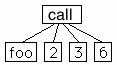
<thought> ::=

        "call" <name> {
<expression> } ";" |
call foo 2 3 6; |
|
The first child is the procedure name, while the remaining
children are expressions. |
<action> ::= "stop" ";" |
stop ; |
|
Leaf node, value is the keyword. |
<block> ::= "{"

          { <command> }

"}" |
{

        turn left;

        forward 5;

        turn right;

} |
|
A block has zero or more children, each of which is a command.
There is no "block" keyword in the grammar, but when you build the tree, create a block token of type KEYWORD. This will not affect the parsing, but will be used in the tree in place of {...}. |
<expression> ::=

[ <addOperator> ]

<term> { <add_operator> <term> } |
foo + 5 |
|
When an <expression> consists of a single term, the
tree is the same as it is for that <term> alone. |
<expression> ::=

[ <addOperator> ]

<term> { <add_operator> <term> } |
2 + 3 + 6 |
|
The shape of the tree is very important; it says 2+3 must be done first. Otherwise, what would be be adding to 6? |
<expression> ::=

[ <addOperator> ]

<term> { <add_operator> <term> } |
-5 |
 |
A unary plus or minus has an expression as its child. |
<term> ::= <factor> { <multiply_operator> <factor> } |
foo * 5 |
|
When a <term> consists of a single factor,
the tree is the same as it is for that <factor> alone |
<factor> ::= <name> |
foo |
|
When a <factor> consists of a name or number<name> or <number>. |
<factor> ::= "("
<expression> ")" |
(foo + 5) |
|
When a <factor> consists of parentheses
around an expression<expression>. The parentheses help the parser determine the shape of the tree, but they don't form a part of the tree. |
<condition> ::= "seeing"
<thing> |
seeing rock |
 |
The <thing> is a child of the seeing or holding node. For not, the child is a <condition> of some sort. |
<condition> ::= <expression> <comparator>
<expression> |
x < 5 |
|
The children of a comparator node are arbitrarily complex
trees representing <expression>s. Only simple expressions
are used in this picture. |
<comparator> ::=

      "<" | "<="| "==" |

"!=" | ">="| ">" |
< |
|
Leaf node, value is the symbol. Similarly for the other
comparators. |
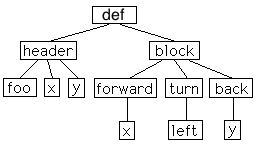
<procedure> ::=

"def"
<name> { <variable> } <block> |
def foo x y {

          forward x;

          turn left ;

          back y;

} |
|
This is the most complex structure. A <procedure> requires a "header" consisting of a <name> and parameters, and a block of <command>s. |
<program> ::= "program"
<block> { <procedure> } |
program {

        forward 5;

          turn left;

          back 1;

        }
|
|
The root node is a program node. The first child is a block of commands, and the remaining children are the
procedures (if any). |
Correct tree shapes
Note that you do not evaluate expressions in the current
assignment! You just need to build the parse tree correctly, so that it could be evaluated.
An operation cannot be performed until its operands are known. When an
operation is represented by a node in a binary tree, that operation cannot be
performed until the children of that node have been evaluated. (This requires
a postorder tree traversal.) Therefore, the structure of the binary
tree imposes restrictions on the order in which operations are performed.
For example, consider the expression 20 * 3 / 4. In this
expression, it is important to do the multiplication before doing the
division. Our parser might construct either of two trees from this
expression, only one of which is correct.
 |
This is the correct representation of 20 * 3 / 4 --if you evaluate the left
and right children, then do the division, the result is (20 * 3) /
4 = 60 / 4 = 15. |
 |
This is a wrong representation--if you evaluate the left and
right children, then do the division, .the result is 20 * (3 / 4)
= 20 * 0 = 0. (Remember, this is integer division.)
|
Due date
Your program is due before 6am Tuesday, March 27. Zip up the entire
directory for this project, and submit via Blackboard. Only assignments submitted via Blackboard
will be accepted--any assignments emailed to me will be discarded without comment. A late penalty of 5 points per day (out of 100 points) will apply.
Because many of you are interviewing this semester, a limited number of 48-hour extensions will be available. To get an extension, email me before 5pm Friday, stating the reason you need the extension. No extensions will be granted after Friday. If you get an extension and fail to get the project in by the extended due date, late points will be counted from the original due date.