- Usually tokenizers for programming languages are pretty similar (most languages have integer literals, for example), but differ enough that tokenizers have to be customized for the particular language. This one is customized for the BNF (meta)language.
read statements, followed by some number of write statements. The read statement reads in one var at a time; the write statement can write out any number (but at least one) of vars.<program> ::= <reads> <writes>.
<reads> ::= { read
<var> }.
<writes> ::= { write <var> {, <var>}}.
<var> ::= a | b | c | d | e.- To recognize and parse programs in the language. You are supposed to write a parser for the BNF metalanguage. You are not (and this is where I got tangled up) suppose to write a parser for your simple programming language.
- To generate programs in the language. In the following steps, you will be generating programs in your simple programming language.
| Key | value | alternate value* |
|---|---|---|
<program> |
||
<reads> |
 |
|
<writes> |
 |
|
<var> |
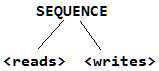

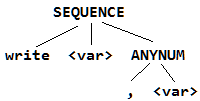
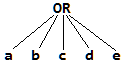
* According to the assignment,
- "When one thing follows another in sequence, make them children of a
SEQUENCEtoken." - "When something may be repeated zero or more times, make that thing the child or children of an
ANYNUMtoken."
ANYNUM node may have many children (in an implicit sequence), or only one. I prefer the first (fewer nodes overall), but the second is also plausible, so I will accept either. <program>", repeatedly expand each nonterminal in the list (that is, replace it by its definition) until there are no nonterminals left. For example,| start with | <program> |
| expand <program> | <reads><writes> |
| expand <reads> |
|
| expand some <var> | read <var> read d read <var> <writes> |
| expand some <var> | read e read d read <var> <writes> |
| expand <writes> | read e read d read <var> write <var>,<var> |
| expand some <var> | read e read d read <var> write a, <var> |
| expand some <var> | read e read d read <var> write a, d |
| expand some <var> | read e read d read e write a, d |
| quit, because no more nonterminals | Write out the generated program. |
Things to note:
- I expanded nonterminals in a somewhat random order, just to show that the order doesn't matter. You will probably expand the first (or the last) nonterminal each time.
- It's easy to work with a list of terminals and nonterminals, then turn it into a string at the last minute. It'sharder to do all the work in a string.
- The program writes out a variable (
a) that it has not read in. This cannot be corrected by BNF alone! BNF is a context-free grammar, which is another way of saying that you cannot use information outside the nonterminal to decide how to expand the nonterminal.